
Down-Hole and Cross-Hole Borehole Seismic Testing
We measure P- and S-wave velocities directly in the borehole, metre by metre: this is the most direct way to obtain the ground stiffness profile, Vs,eq and the ground category for design.
How a Down-Hole test is performed
A triaxial geophone (3C) with a wall-anchoring system is lowered into a survey borehole lined with PVC casing and cemented in place. At the surface, a few metres from the borehole collar, the impulse is generated: a vertical strike on a plate for P waves, and horizontal strikes on a beam, in opposite directions, for SH waves. The polarity reversal of the S waves between the two strikes makes it possible to identify the first arrival reliably.
Measurements are repeated at regular intervals, typically every metre, from the surface to the bottom of the borehole. Arrival times, corrected for the oblique path, are used to construct P- and S-wave travel-time curves and determine interval velocities layer by layer.
Vs,eq and ground category
The Technical Standards for Construction (D.M. 17/01/2018) classify the subsoil according to the equivalent shear-wave propagation velocity:
Vs,eq = H / Σ (hᵢ / Vs,ᵢ)
where hᵢ and Vs,ᵢ are the thickness and velocity of the i-th layer, and H is the depth to the bedrock, defined as a formation with Vs not less than 800 m/s; if the bedrock is deeper than 30 m, H = 30 m is used. The Vs,eq value and bedrock depth determine the ground category—from A to E—used to define the design seismic action.
Cross-Hole
In a Cross-Hole test, the source and receiver are positioned at the same elevation in two or more aligned boreholes: waves travel horizontally and velocity is measured layer by layer at high resolution, including where thin layers or velocity reversals are present. Borehole verticality is checked to correct the actual distances.
What we provide
- P- and S-wave travel-time curves
- Vp and Vs interval velocity profiles
- Vs,eq and ground category (NTC 2018)
- Vp/Vs ratio and Poisson's ratio
- Dynamic elastic moduli G₀ and E₀ at small strains
- Comparison with MASW, HVSR and borehole stratigraphy
From borehole geophone to Vs profile
The triaxial geophone is lowered into the borehole; at each depth, the surface source generates a P wave and an S wave, whose first arrivals are recorded and plotted on travel-time curves. Their slopes yield interval velocities and, over the first 30 m, Vs,eq. In this example, using illustrative values, Vs,eq is approximately 316 m/s, corresponding to ground category C.
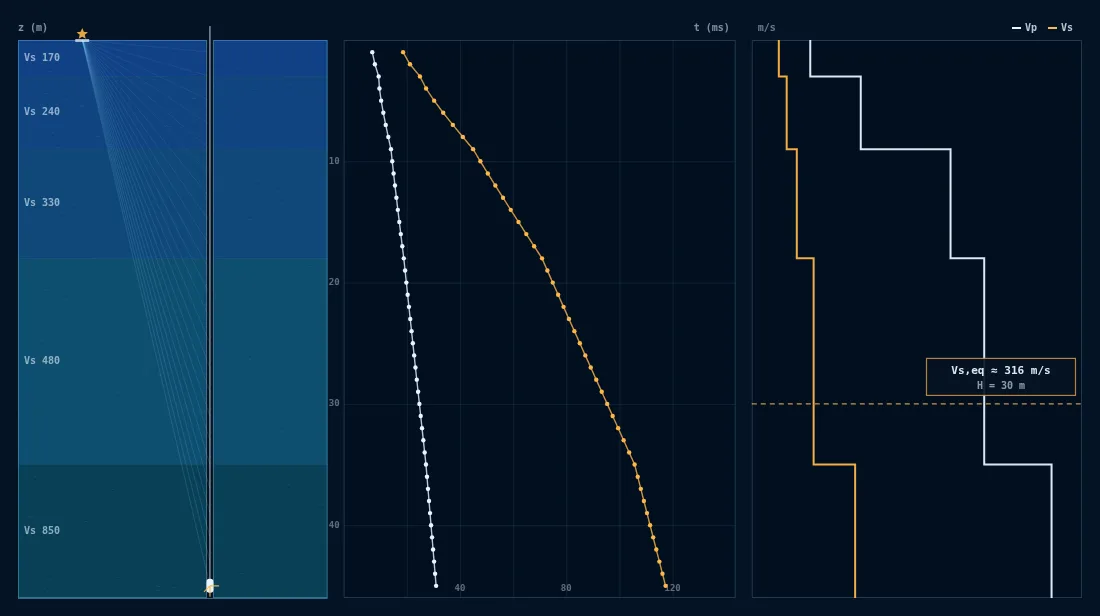
- P waves
- S waves
- Vs,eq over the first 30 m
Frequently asked questions
When should you use a Down-Hole test instead of MASW?
MASW is a surface method that is fast and cost-effective, producing a Vs profile averaged over the array. Down-Hole measures arrival times directly along the borehole, with metre-scale resolution and without relying on assumptions about the model: it is preferable for major projects, ground with velocity reversals, or when a borehole is already available.
How is Vs,eq calculated under NTC 2018?
The equivalent velocity is calculated as Vs,eq = H / Σ(hᵢ/Vs,ᵢ), where hᵢ and Vs,ᵢ are the thickness and velocity of each layer and H is the depth to bedrock, that is, a formation with Vs not less than 800 m/s. If bedrock is deeper than 30 m, H = 30 m is used.
What is needed to carry out the test?
A survey borehole lined with PVC casing and cemented with a suitable grout to ensure coupling between the casing and the ground. Cross-Hole requires at least two aligned boreholes, with verticality checked. We can provide conditioning specifications before drilling.
Often combined with this survey
Ready to get your project underway?
Send us the location and objectives of the survey: we will recommend the most suitable combination of methods and provide a detailed quote.